

Marine robotics are evolving fast. Between ROV, AUV and USV, In this context, it's difficult to know which solution to choose for an inspection, mapping or environmental mission.
At ROV Expert, We support manufacturers, ports, dams and offshore players in the selection and integration of these systems. Here's a clear guide to the differences.
What is an ROV?
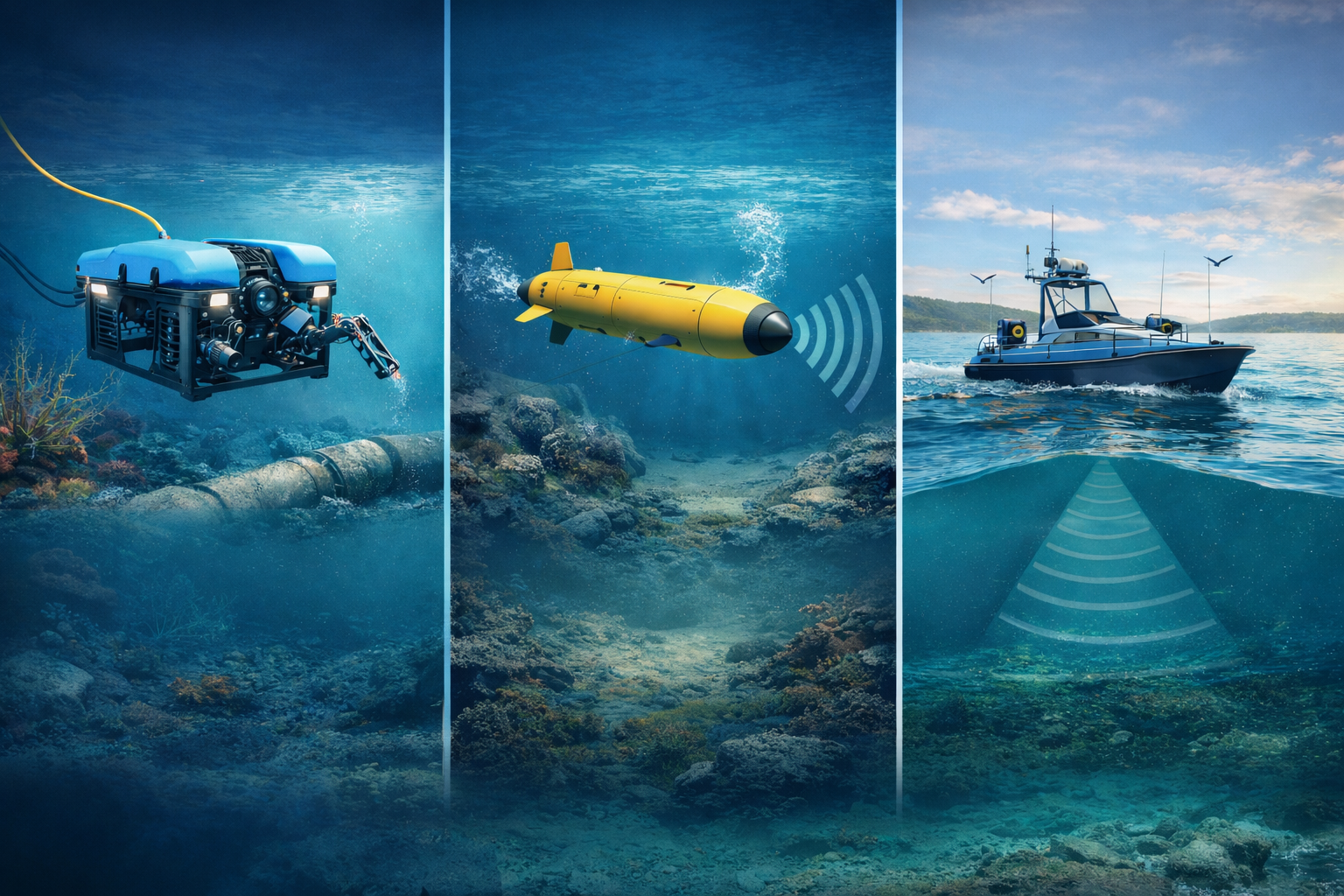
A ROV (Remotely Operated Vehicle) is an underwater robot controlled from the surface via a cable (umbilical).
A well-known example:
BlueROV2
✅ Advantages :
- Real-time control
- Ideal for precise visual inspection
- Possibility of adding manipulator arm, sonar, DVL...
- Immediate response to problems
❌ Limits:
- Dependent on an umbilical
- Mobility limited by cable length
- Requires an operator
📌 Typical use cases :
- Dam inspection
- Hull inspection
- Port inspection
- Search for submerged objects
The ROV remains the most versatile solution for industrial inspection.
What is an AUV?
A AUV (Autonomous Underwater Vehicle) is an autonomous underwater robot that executes a programmed mission without a real-time pilot.
Main features :
- INS / DVL / sonar navigation
- Pre-programmed missions
- Battery-operated
- Often torpedo-shaped“
✅ Advantages :
- Long autonomy
- Ideal for long-distance bathymetry
- No umbilical
- Very stable for data acquisition
❌ Limits:
- High cost
- Less flexibility in case of unforeseen events
- Post-processing often necessary
📌 Typical use cases :
- Bathymetric mapping
- Long-distance offshore survey
- Scientific acquisition
AUV is preferred for large-scale systematic mapping missions.
What is an SVU?
A USV (Unmanned Surface Vehicle) is a marine surface drone.
Example:
BlueBoat
✅ Advantages :
- Surface operation
- Perfect for multibeam sonar
- Simple deployment
- Can be used as acoustic relay for ROV/AUV
❌ Limits:
- Can't see directly underwater without sonar
- Sensitive to weather conditions
📌 Use case :
- Port bathymetry
- Dam inspection
- Environmental surveys
- Acoustic support (USBL)
The USV is often the most cost-effective solution for bathymetric surveys in quiet areas (harbors, dams, reservoirs).
🔎 ROV vs AUV vs USV quick comparison
| Criteria | ROV | AUV | USV |
|---|---|---|---|
| Control | Teleoperated | Stand-alone | Teleoperated / Autonomous |
| Depth | Yes | Yes | No (surface) |
| Visual inspection | Excellent | Limited | No |
| Wide-area mapping | Medium | Excellent | Excellent |
| Cost | €€ | €€€€ | €€ |
| Field responsiveness | Very high | Average | High |
Which solution to choose?
Precise inspection, maintenance, intervention?
✅ ROV
Offshore long-distance mapping?
✅ AUV
Port or dam bathymetry?
✅ USV
In certain complex projects (industrial ports, strategic dams), the combination of USV + ROV often offers the best compromise.
Trend 2026: hybrid systems
We are seeing the emergence of :
- ROV with INS/DVL assisted navigation
- USV as mother station for ROV
- Compact AUVs for local missions
At ROV Expert, we develop hybrid architectures combining :
- Industrial ROVs
- Bathymetric USV
- Advanced sensors (DVL, multibeam, sonar imaging)
Conclusion
There is no such thing as a “best” universal system.
The choice always depends on :
- Depth
- Area to be covered
- Type of data required
- Budget
- Level of in-house expertise
🔵 The ROV remains the benchmark for technical inspection.
🟠 AUV dominates long-distance mapping.
🟢 The USV is the modern, cost-effective solution for surface surveys.