






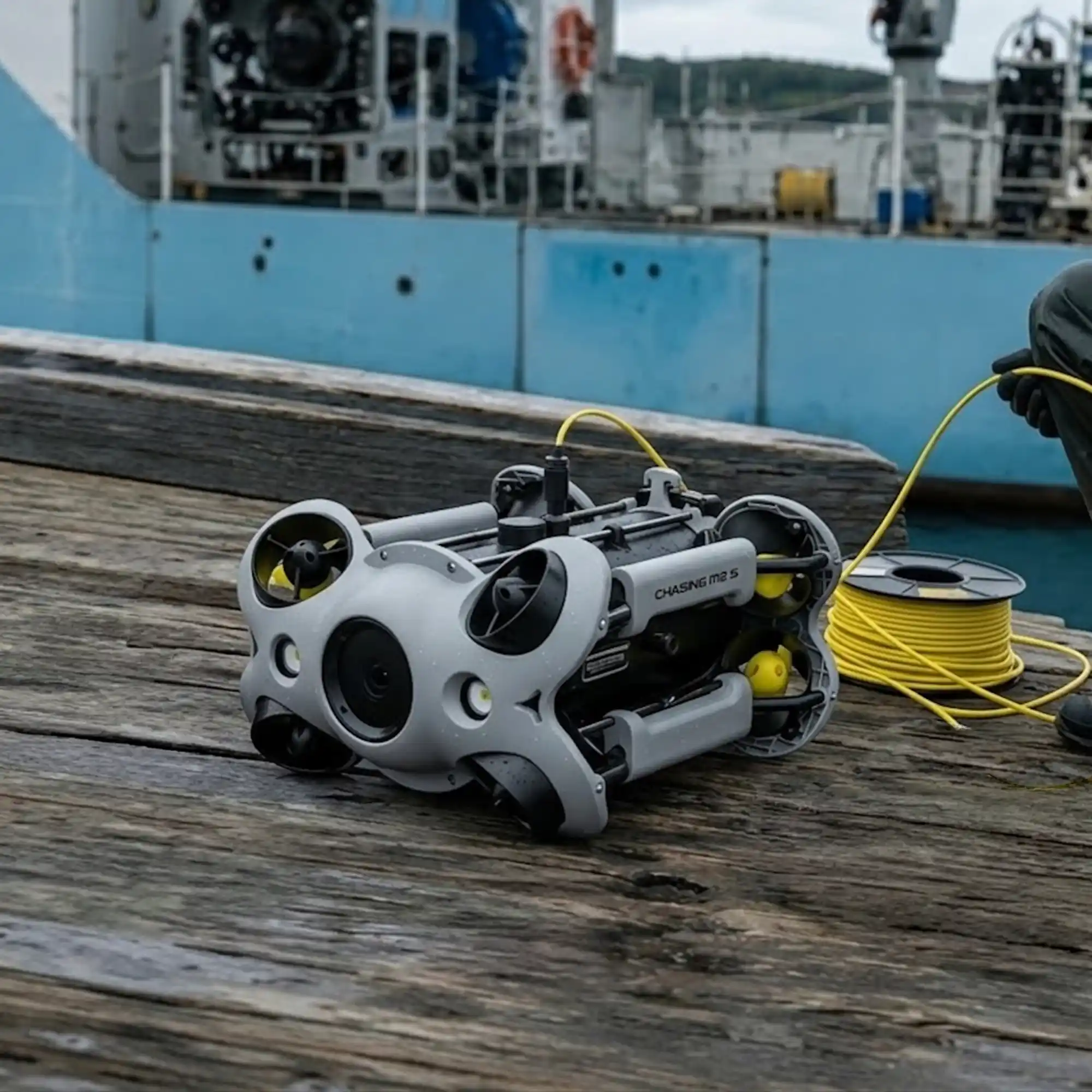
The success of an underwater inspection does not depend solely on the ROV's performance.
It depends mostly on the preparation of the mission beforehand.
In professional environments (ports, industries, hydraulic works, or submerged structures), a poorly prepared mission can lead to:
- a significant waste of time
- unusable data
- material risks for the ROV
- seeing the impossibility of completing the inspection
This is why rigorous preparation and a systematic pre-launch checklist are essential.
Why is preparing for an ROV mission so important?
An underwater inspection mission combines several constraints:
- environment often unknown or poorly accessible
- limited visibility at times
- presence of currents or obstacles
- strong dependence on electronic equipment
Unlike a land inspection, every mistake can have an immediate impact underwater.
Good preparation allows for:
- secure the ROV
- optimize intervention time
- ensure the quality of the collected data
- avoid mission interruptions
Clearly define the mission objectives
Before any launch, it is essential to structure the mission.
We must identify:
- the type of inspection (structure, tank, hull, hydraulic structure, etc.)
- priority areas to analyze
- The expected level of precision
- Data to be collected (video, photo, sonar, measurements)
- Operational constraints (limited time, operating site, etc.)
A ROV is only effective if the mission is clearly defined.
Site condition analysis
Each underwater environment is different.
The main parameters to analyze are:
- maximum depth
- Flow and turbulence
- water turbidity
- Potential obstacles (cables, structures, debris)
- access to launch point
- Weather conditions if outside environment
This step allows us to anticipate risks and adapt the ROV's configuration.
Preparing the ROV and equipment
A professional ROV must be inspected before each mission.
Essential checks include:
- propulsion status
- Propeller inspection
- sealing joint inspection
- Connections and cables check
- main camera test
- Lighting check
- Battery level and status
- Tether inspection
A single anomaly can compromise the entire mission.
System configuration before immersion
Before launching, the systems must be correctly configured:
- sensor calibration
- Camera settings (resolution, exposure, FPS)
- live video feedback test
- navigation system check
- Mission parameters recording
This step ensures the ROV is operational upon immersion.
Complete checklist before launching
This is the last critical step before launch.
✔️ Technical checks
- No damaged cables
- functional and free propellers
- fully charged battery
- stable connection between surface and ROV
- Camera and lighting operational
- Pressure and leak testing
✔️ Operational Checks
- Secure boat launch area
- no obstructions in the perimeter
- team briefed and positioned
- role of each operator defined
✔️ Mission Checks
- objectives clearly recalled
- identified inspection zones
- trajectory or defined mission plan
- Estimated duration confirmed
This checklist greatly reduces human errors.
Mission launch
The first few minutes are crucial.
We recommend:
- A surface buoyancy test (if the ROV allows)
- a complete check of orders
- a gradual descent
- a real-world sensor test
Any anomaly detected at this stage must be corrected immediately.
The most common mistakes
Some errors occur regularly:
- launch without full thruster testing
- Link cable check forgotten
- Poor assessment of the actual site conditions
- lack of communication between operators
- non-standard checklist
These errors can lead to material loss or unusable data.
Conclusion
An underwater inspection mission doesn't start at the water's edge, but well beforehand.
Preparation is a determining factor of success.
A structured checklist allows you to:
- secure the hardware
- improve the quality of inspections
- Reduce operational risks
- standardize interventions
Need support for your ROV missions?
At ROV Expert, we support professionals in:
- Choosing the right ROV
- mission preparation
- Optimization of underwater inspections